


Altamira International School
Preschool
The Altamira International School is committed to providing a holistic education that develops all human dimensions: cognitive, socio-emotional, aesthetic, physical and spiritual to form a leading citizen that promotes a culture of service, honesty and respect.
Recognizing the contributions that Reggio Emilia's philosophy has made at the global level in understanding the rights of children as builders of culture and participants in their identity and autonomy. The directive and the teachers of the AIS preschool school have been tasked with examining and studying the proposal that since 1980 (in a place in northern Italy, in the Emilia Romagna region, the city of Reggio Emilia) has been a model for those engaged in child education.
Altamira considers children as beings capable of creating and building meanings, capable of using a complex learning network that can only be interpreted through the teacher's listening attitude.
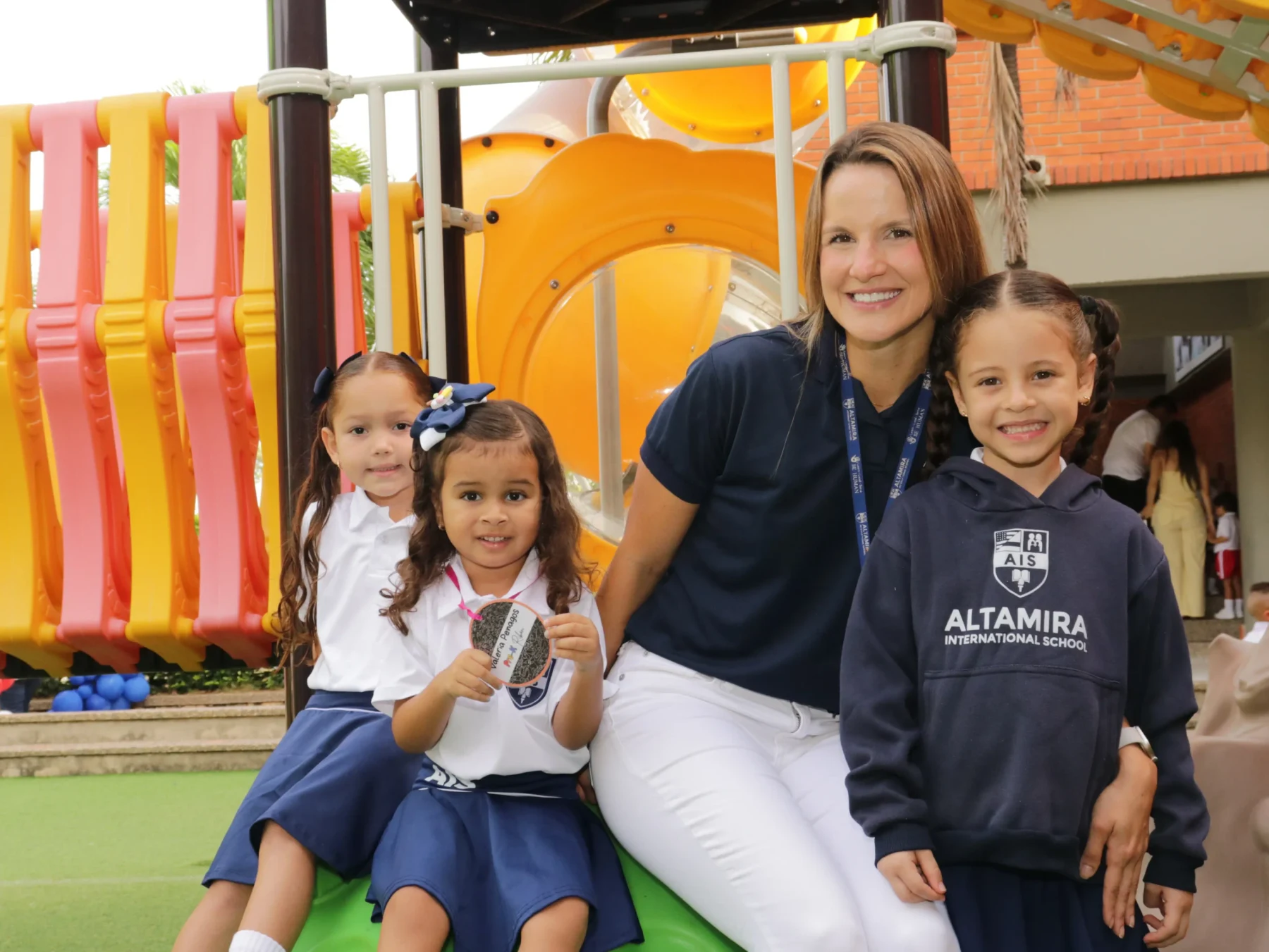
Any action taken by children is considered a genuine gift and the priority for the team is to present in the photographic records what they do and what they can do. The classrooms are spaces with an identity of those who inhabit it, where the processes of knowledge that take place there are visible and where the actions and paths that have been taken are visible.
Upon entering the AIS, the visitor can appreciate and understand the life in the school, its history and its identity in the shared documentation on the panels.
The AIS promotes the spirit of research and seeks to train children as responsible citizens, critical and creative thinkers capable of solving problems. In the centers or areas of exploration within the classroom, students ask themselves to do research that comes from the hypotheses they express in their conversations.
There are multiple spaces, games, dialogues and exploration where children express their 100 languages. (Loris Malaguzzi, pedagogo and precursor of this educational philosophy). At hand, parents and teachers, in close relationship, participate in the creative development of children's symbolic, logical, fantastic, cooperative, social and emotional languages.
The language of music allows the child to communicate with his or her interior and between them, stimulates imagination and creativity. Song and percussion are the first elements of rhythm in the smallest. "Music Studio" creates a rich environment that promotes self-esteem and promotes social, emotional and intellectual development.
ATELIER or art studio. In this space, children converge to explore, through artistic techniques, the themes through which they turn their daily concerns. Sensitivity can be explored through many means and forms. The Atelier is a space for children to meet with their creativity.
Dance and body expression is another language that communicates emotions and supports non-verbal expression and communication, developing skills and skills.
Children are immersed in a bilingual environment that encourages the development of communication skills. In both the internal and external classroom, oral and written communication constantly enriches the literacy process in English and Spanish. By investigating and solving problems in a creative way in the encounters with mathematics, children can understand the world around them, appreciate and enjoy from an early age, discovering that mathematical thought is everywhere.
It is the responsibility of the AIS to share with the community through the walls of the institution and to reach out to other educational entities through educational meetings and dialogues that encourage the exchange of knowledge. Moments such as the Mathematics Congress, the International Presence Initiative, the month of reading and others enrich the processes of collaboration and solidarity among learning communities.